President’s Desk
Dear all Steel Stakeholders,
Steel Users Federation of India now popularly known as ‘SUFI’ has achieved remarkable success in a short span of time to bring various stake holders of steel industry on a common platform and is marching towards achieving its objective to achieve higher per capita consumption of steel and thereby promoting growth and excellence in steel industry.
SUFI has more than 7000 members across India and chapters in various states. SUFI has always acted proactively as an interface between government and steel industry and trade.
SUFI has been instrumental in creating awareness about GST, published GST-DECODED FOR STEEL, held workshops and help–desk for GST, held steel conferences in India and abroad and have regularly engaged with the government on various policy issues. SUFI provides PAN India presence with a democratic, honest and focused approach to address the members / member association’s problems and take them up suitably with relevant authorities with result oriented approach.
As a humble President of SUFI, I am sure that this federation has marked its presence and is catering to the needs by becoming a fountain of support for Indian steel industry.
I sincerely hope steel fraternity will appreciate our efforts.
With Warm Regards,
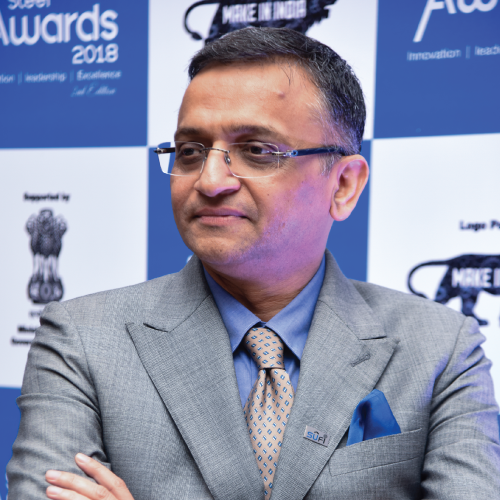
Nikunj Turakhia (President)
President
Steel Users Federation of India
Nikunj Turakhia (President)
Dear all Steel Stakeholders,
As we move through 2026, the global steel industry continues
to remain at an important crossroads, with weak global demand, rising excess
capacity, changing trade policies and geopolitical uncertainties shaping
the market. According to the OECD Steel Outlook 2026, global steel demand is
projected to grow by only around 0.4% in 2026, while global steelmaking
capacity has reached a record 2.445 billion tonnes. Excess capacity
stood at around 640 million tonnes in 2025 and is projected to increase
further to 745 million tonnes by 2028. These developments are creating
increasing pressure on steel prices, profitability and international trade.
In this challenging global environment, India continues
to stand out as one of the strongest growth markets for steel.
Infrastructure development, manufacturing, urbanisation, renewable energy and
increasing domestic consumption continue to support the country’s steel demand.
India has also remained one of the major contributors to global steel capacity
expansion, supported by comparatively stronger domestic demand. The opportunity
before India is significant, but it is equally important that the
competitiveness of the entire steel value chain—including manufacturers,
processors, traders and steel users—is protected and strengthened.
However, the road ahead is not without challenges. Global
excess capacity and increasing exports from surplus-producing countries are
putting pressure on steel markets across the world. China exported a record 131
million tonnes of steel in 2025, reflecting the impact of weak domestic
demand and surplus production. Countries across the world are consequently
strengthening anti-dumping, safeguard and other trade measures. The global
steel industry is therefore moving towards a period where fair competition,
transparency and a level playing field will become increasingly important.
For India, the balance between protecting domestic industry
and ensuring the availability of quality steel at competitive prices for
downstream industries remains extremely important. Steel users require
access to the right quality, specifications and grades of steel at globally
competitive prices. Any restriction that prevents manufacturing units from
obtaining specialised or superior-quality raw materials can ultimately affect
the competitiveness of the downstream industry and, consequently, the larger
objective of Make in India. At the same time, policy measures need to
provide adequate protection against unfairly traded imports while ensuring that
genuine and essential requirements of steel users are not adversely affected.
Geopolitical tensions, disruptions in global supply chains
and uncertainty surrounding international tariff policies continue to affect
trade and investment decisions. The increasing use of tariffs and trade
remedies by major economies has made international steel trade more complex.
Stability and predictability in policy remain essential for businesses to plan
investments, develop markets and build long-term supply chains. The steel
industry, being fundamental to infrastructure and manufacturing, requires an
environment where both producers and users can operate with confidence.
In this evolving environment, SUFI continues to play an
important role in representing the interests of steel users and bringing
together the various stakeholders of the steel ecosystem. Our objective
remains to facilitate constructive dialogue between steel users, mills,
traders, service providers and policymakers, while ensuring that the concerns
of the user industry receive due consideration.
One of the significant developments for SUFI during 2026 was
the signing of a Memorandum of Understanding with the National Stock
Exchange of India (NSE) in May. The collaboration is aimed at supporting
the development and growth of the steel and related commodity derivatives
ecosystem, including the HRC Futures Index. I believe that developing
transparent and efficient market mechanisms will contribute towards better
price discovery and provide industry participants with improved tools for
managing price risks. The MoU marks another important step in strengthening the
institutional framework around the Indian steel market.
SUFI has also continued to strengthen its international
engagement. Building on our international initiatives and the launch of SUFI
International Chambers, we remain focused on facilitating international
companies seeking to establish or expand their presence in India’s steel
sector. The initiative is intended to assist companies with matters such as
setting up offices, company formation, policy-related requirements, taxation
support, steel-sector market information and business networking. The recently
concluded AGM also reaffirmed the importance of strengthening and developing
SUFI International Chambers as an important platform for international business
facilitation and cooperation.
As we look ahead, the Indian steel industry has an important
opportunity to strengthen its position in the global market. Higher per
capita steel consumption, stronger domestic manufacturing, infrastructure
development and greater integration with global markets can provide the
foundation for sustained growth. At the same time, India must remain conscious
of global overcapacity, trade distortions, raw-material security,
sustainability requirements and the evolving nature of international trade.
SUFI will continue to work towards a stronger, more
competitive and inclusive steel ecosystem, ensuring that the voice of steel
users remains an integral part of industry and policy discussions. I am
confident that through cooperation, constructive dialogue and collective
effort, we can convert the challenges facing the steel industry into opportunities
for sustainable growth.
Let us continue to collaborate, innovate and work together
towards higher steel consumption, stronger industry participation and a
globally competitive Indian steel sector. India has the potential to play
an increasingly important role in shaping the future of the global steel
industry, and SUFI remains committed to contributing meaningfully to this
journey.
Warm regards,
Nikunj Turakhia
President
Steel Users Federation of India